All our products and supplements are tailor-made and crafted to perfectly align with each customer's unique needs and preferences. Purchasers are advised to know their requirements.
The effects of Vitamin C on reproductive performance in breeding poultry and sows
Blog post description.
1/13/20261 min read
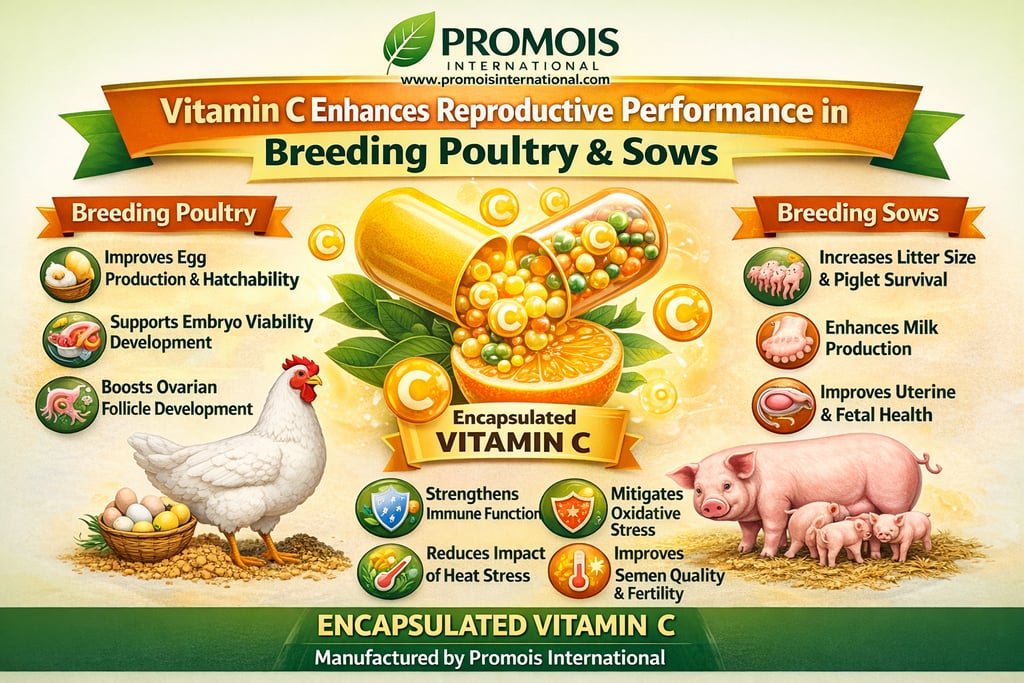
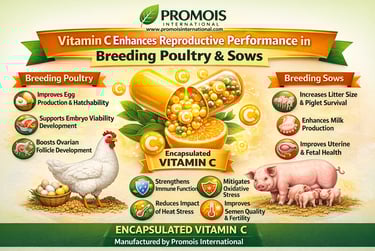
Vitamin C (ascorbic acid) plays a significant role in enhancing reproductive performance in both breeding poultry and sows. In poultry, supplementation of vitamin C has been shown to improve egg production, hatchability, and embryo viability by supporting oxidative stress reduction and immune function (Kumar et al., 2018). It also enhances ovarian follicle development and stabilizes hormonal balance, leading to better reproductive outcomes (Ahmed et al., 2019). Similarly, in sows, vitamin C supplementation during gestation has been associated with increased litter size, improved piglet survival rates, and enhanced milk production (Gao et al., 2020). Vitamin C contributes to collagen synthesis, which is vital for uterine health and foetal development (Kumar et al., 2018). Additionally, it mitigates oxidative stress during pregnancy, thereby reducing embryonic mortality and improving overall reproductive efficiency (Gao et al., 2020). Stress factors such as heat stress can impair reproduction, but vitamin C supplementation has been shown to alleviate these effects by supporting immune responses (Yao et al., 2017). In poultry, vitamin C has also been linked to improved semen quality and fertility in breeding males (Saleh et al., 2021). The antioxidant properties of vitamin C help maintain cellular integrity in reproductive tissues, contributing to better fertility outcomes (Ahmed et al., 2019). Vitamin C supplementation appears to be a beneficial strategy to enhance reproductive performance in breeding poultry and sows, especially under stress conditions (Gao et al., 2020).
Promois International (www.promoisinternational.com) is one of the best-known manufacturers of encapsulated vitamin C.
Promois International
manufacturer and exporter of livestock feed aditive and supplements. Supplier of cosmetic chemicals and ingredients.
Information
Promois International has grown to one of the World’s Largest Integrated Premium Quality and Halal Chemical sources. Promois has wholly-owned subsidiaries and joint venture companies that span the globe and employ thousands of people.
India
© Copyright .PROMOIS INTERNATIONAL LT. All Rights Reserved
Useful Links
Disclaimer: The company Promois International Lt. is dealing in feed supplements like Tailored Amino Acids and other feed suppliments with specific novel nature and all terms and conditions of the sell/purchase are detailed on the official website of the company at https://www.promoisinternational.com and the user/purchaser/trader hereby binds himself to all terms and conditions of the company by placing reliance on the email/trade with Promois International Lt.
The Promois International Lt. is a company that deals with tailor-made products, and the same is made based on the person/company/customer/user’s demand, considering their budget, and the company is not engaged in dealing with any generic products. Hence, the user/Trader/Customer hereby agrees and accepts his /her/its responsibility to satisfy himself/herself/itself as to the suitableness & completeness of such information for his own particular use. Sold and supplied goods will not be returned or replaced or refunded in any circumstances since they are tailored products. None of the products sold by the company are pharmaceutical products and/or products which are meant for human consumption.
This information relates only to the specific material/products designated and may not be valid for such material used in combination with any other materials and/or in any other process. It is advised and recommended that the product/material should be partially replaced at the beginning instead of totally replacing the regular/general products with our product/s. Such information is to be the best of the company's knowledge and believed to be accurate and reliable as of the date indicated. However, no representation, warranty, or guarantee of any kind, express or implied, is made herein as to its accuracy, reliability, or completeness, and we assume or accept no responsibility for any loss, damage, or expense, direct or consequential, arising out of use. The product may not be what is written as they are tailor-made based on the user/trader/client's needs of physical appearance, chemical performance, and prices needed by the client. The products may also need a reagent for assay analysis.
Our products are formulated using specific chemistry to achieve targeted assays and characteristics comparable to market products, offering a cost-effective and value-for-money solution. These products can be evaluated only through a specific Method of Analysis (MOA). Adelbert products not evaluated/tested by an HPLC or any other test protocol, its strictly for use. Specific MOA shared at the beginning of communication regarding the purchase of material.
Promois International Lt supplies products which are tailored to suit customer requirements in terms of physical, chemical nature, and price, as acceptance of their quality & price standards. Hence, traders/retailers may be cautioned when they purchase goods from Promois International Lt and sell further in the market that they shall be bound to disclose all MOA, COA, and other important terms and conditions of the product purchased from Promois International Lt.
The Promois International Lt shall not be held responsible for any kind of misrepresentation and/or further trade being done by the purchaser/trader/end user under any circumstances.
The products are made based on the need and budget of the user /purchaser, using chemistry to give specific assay results and characteristics to match other market products and to give a cheaper solution and value for money but not deal any generic products. They can be evaluated by a specific MOA (Method of Analysis) and COA (Certificate of analysis) only. That is why they are cheaper compared to other products in the market. Promois International Lt represents to trader/purchaser very clearly through the COA and invoices, and literature about the same. The trader/purchaser is directed to convey to their end customers as well. Failing to do this will lead to confusion and legal situations, and in such events the Promois International Lt shall not be held responsible. Also, as per our company policy, any material previously purchased from Promois International Lt. and accepted by the buyer will be considered as finally approved goods from the buyer, and all future purchases shall be subject to same terms and conditions as the earlier one, and no further communication regarding those past or future supplies will be entertained on the grounds of non-communication of terms. This Disclaimer/message will be treated as your final acceptance of all past, present, and future supplies. This acceptance shall remain valid for all purchases made in the past, present, and future.
The company shall not be held responsible in the event if the goods are sold in different packaging other than the company’s original packaging.
Any trade with Promois International Lt shall be deemed to be subject to jurisdiction at Kanpur, U.P., India and any proceedings including arbitration proceedings arising out of any future dispute/issue shall be by held by Sole Arbitrator, to be appointed by Promois International Lt and such proceedings shall be held at Kanpur, U.P. and/or at Mumbai, Maharashtra, at sole discretion of Promois International Lt and the Purchaser/Trader/person purchasing hereby agrees to the same and no other place shall have jurisdiction, except mentioned herein shall have jurisdiction to any future dispute.
By proceedings further, the user/consumer/customer/trader agrees to the terms and conditions mentioned herein and also acknowledges the representation of the Seller/Company, namely Promois International Lt and by placing on reliance of present email, the purchaser/customer/trader is binding by the basic terms and conditions & policy of Promois International Lt and shall not be dispute the same in future before any Authority/Court.